




In the UK, breast implants are regulated by the Medicines and Healthcare products Regulatory Agency (MHRA) rather than the US Food and Drug Administration (FDA).
However, there is still a great deal of confusion around whether or not breast implants in the UK need to be FDA approved.
The FDA is a US government agency that is responsible for protecting public health by regulating medical devices, including breast implants.
The MHRA, on the other hand, is the UK’s regulatory body for medical devices and is responsible for ensuring that all medical devices, including breast implants, meet certain safety and quality standards before they can be marketed and sold in the UK.
While the MHRA does not require breast implants to be FDA approved, it does require them to meet the same safety and quality standards as medical devices that are approved by the FDA. This means that breast implants sold in the UK must be tested for safety and effectiveness, and must meet strict manufacturing and labelling requirements.
However, there are a wider range of implants available in the UK compared with the US and not all of the implants that we use in the UK have been approved by the FDA.
It is important to note that there have been concerns in the past about the safety of certain types of breast implants, including those filled with silicone gel. In 2019, the FDA issued a recall of certain textured breast implants due to their link to a rare form of cancer called breast implant-associated anaplastic large cell lymphoma (BIA-ALCL). While this recall did not affect all breast implants, it highlights the importance of ensuring that all medical devices, including breast implants, are rigorously tested and regulated for safety.
In conclusion, breast implants in the UK do not need to be FDA approved, but they must meet the same safety and quality standards as medical devices that are approved by the FDA.

Angelina Jolie has announced today that she has undergone an elective double mastectomy to reduce her risk of developing breast cancer. We are becoming better and better at diagnosing and treating breast cancer to the extent that we can now look at various risk factors, in particular family history and genetic testing, to identify individuals who are at high risk of developing cancer, and treat them before the disease has had a chance to develop. This may sound like something out of science fiction, but in fact it is something that is increasingly done and widely available on the NHS. The news today that Angelina Jolie has undergone a double mastectomy for this reason will increase public awareness and help patients who are undergoing mastectomy or who have had mastectomy to realise that it is still possible to be beautiful and feminine after mastectomy. One can only imagine how difficult a decision this can be for any woman, and Angelina Jolie is to be commended for making these personal details public.
Breast cancer is the most common cancer in the UK and Angelina Jolie is one of a list of high profile celebrities who have been affected by it including Kylie Minogue and Sharon Osbourne. It can affect women as well as men and there are a variety of treatments including surgery, radiotherapy and medical treatments. Outcomes can be very good with a move towards less radical surgery and better reconstruction techniques, which means that women can lead normal lives following a diagnosis of breast cancer.
Just as the methods of diagnosing and treating breast cancer are advancing, so are the methods of breast reconstruction. A breast reconstruction is still a major undertaking and not every patient will be ready for it, but with advances in surgical techniques such as the DIEP flap and fat grafting, we are now able to give natural and long-lasting results. People often think of breast implants when thinking of breast reconstruction, but this is only one of the methods available. The majority of my reconstructions use the patient’s own tissues, either from the abdomen (DIEP flap) or the back (extended latissimus dorsi flap). These operations take longer and are more complex than using implants but once they are finished, the result is often more natural. Furthermore, even though the operations take longer, they will often allow you to avoid having further operations in the future.
The way I see it, if you are considering having a breast reconstruction, you will probably need a certain amount of time in theatre and you can choose how you break up that time.
Option 1: you have a DIEP flap, which takes 8 -10 hours in theatre and is a big undertaking, but once it is done, you will probably only need minor procedures such as dog ear removal or nipple reconstruction. This is a way of frontloading all of the time in theatre at the beginning of your treatment.
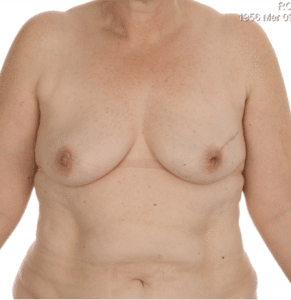
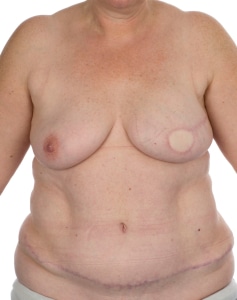
Option 2: you have an extended latissimus doris flap (ELD flap). This takes about 5 hours in theatre and is not as major a procedure as a DIEP flap, but the reconstruction that it provides will be smaller. Obviously, if your breast is smaller, then it may be enough, however, usually patients with small breasts, have slim backs and so it may still not be quite big enough, and so there are then 2 options:
Option 2a: an ELD flap with an implant. An implant can be placed beneath the extended latissimus dorsi flap to enhance the volume, however implants do carry with them additional potential complications. Among the complications of implants is a condition called capsular contracture. This is hardening of the implant and can happen to any implant, but occurs more quickly in patients who have had or are having radiotherapy. If the implant develops capsular contracture, then it may need to be changed and this can happen after around 5-10 years, or sooner in the presence of radiotherapy. When the implant is changed, then there is a risk of capsular contracture occurring in the next implant and it can come more quickly second time around. This means that, although the operation is quicker, there is the potential for further surgery every 5 or 10 years afterwards and so the total time in theatre over the lifetime of the reconstruction will even out.
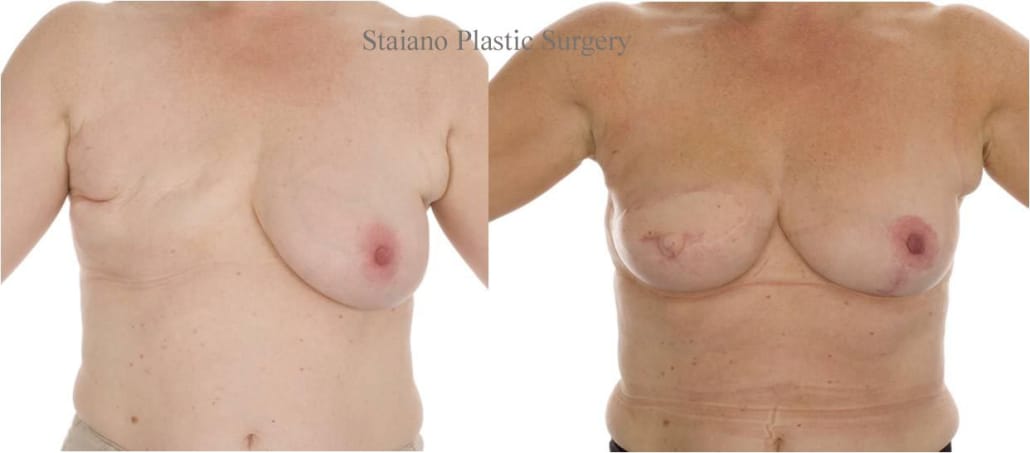
Option 2b: an ELD flap followed by fat grafting. If the ELD flap is too small and you do not want the potential problems associated with implants, then you can accept that it will be small to start with and then build it up with fat grafting at a later date. I like to wait at least 3 months between operations, but fat grafting can give a useful increase in volume to the reconstruction and can also be tailored to fill in contour irregularities or deficiencies. It may only be a modest increase in volume that fat grafting can give and so it may need to be repeated, depending on the size of the breast reconstruction that you require. So you can see, an ELD flap with implant may require further operations every 5 or 10 years, and an ELD flap followed by fat grafting may require further surgery every 3 months until it is up to the required size. Once the size is achieved, then a breast reconstruction using ELD flap and fat grafting is a permanent solution, similar to a DIEP flap and should age and mature with you.
#askjj
Read Jonathan's book now!
Jonathan is on a one man crusade to revolutionise the image of cosmetic surgery and is passionate about spreading his message about cosmetic surgery training.