




Who Should Remove My Mole: Dermatologist vs Plastic Surgeon?
If I’m worried about a mole, who should I see – Plastic Surgeon or Dermatologist?
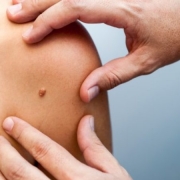
If your main goal is to have a mole removed safely and with the best possible scar, it often makes sense to start with a plastic surgeon. Plastic surgeons are surgical specialists: they are trained in precise excision, layered closure, scar placement, and reconstruction particularly in cosmetically sensitive areas like the face, neck, and chest.
A dermatologist is most useful when you want overall skin care advice (for example acne, eczema, rosacea, sun damage, anti-ageing, skincare routines), or when you have many moles and want a full-body skin check, mole mapping, and long-term surveillance.
Important: if a mole is new, changing, bleeding, crusting, painful, itchy, irregular, or looks different from your others, do not delay medical assessment. That may mean speaking to your GP urgently for referral, or seeing a clinician who will examine the lesion properly and ensure any removed tissue is sent for laboratory testing.
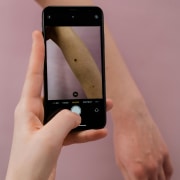
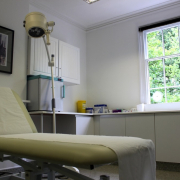
We are one of the few clinics in the country who will offer an expert assessment by a plastic surgeon by sending us a photo of your mole and if it requires removal, we aim to offer treatment within 7 days, in one of our ‘See & Treat’ Clinics.
Quick decision guide
- See a plastic surgeon first if you want removal (especially on the face/neck), you care about scar quality, or you suspect the lesion will need a careful closure.
- See a dermatologist if you want general skin care advice, you have multiple moles and want a full skin check or monitoring plan, or you need broader management of skin conditions.
- Choose a medical pathway urgently if the mole looks suspicious. Whichever specialist removes it should preserve the tissue and send it for histology where appropriate.
Why starting with a plastic surgeon often makes sense
When people ask who should remove my mole? they are usually asking about the removal itself: technique, comfort, and scarring. This is where plastic surgeons tend to have a clear advantage because their day-to-day work is surgical. They routinely:
- Plan incisions along natural skin lines to reduce scar visibility
- Use layered closure to support better healing
- Manage high-tension areas where scars can widen
- Perform reconstruction (flaps/grafts) when a lesion is large or in a tricky position
- Advise on aftercare that supports optimal scar maturation
This is especially relevant for cosmetic mole removal and for lesions on the nose, eyelids, lips, cheeks, ears, jawline, neck, decolletage, and hands, where small differences in technique can change the final appearance.
What about safety if the mole might be abnormal?
Safety depends on proper assessment and when needed laboratory testing of the removed tissue. You can still start with a plastic surgeon, but you should choose one who will:
- Examine the lesion clinically
- Explain whether the features are reassuring or concerning
- Remove the lesion using an approach appropriate for diagnostic accuracy
- Send the specimen for histopathology when there is any uncertainty
- Tell you what happens next if results show atypia or cancer
A new mole or a change in an existing mole can be a sign of melanoma and a specialist may remove the mole and surrounding skin so it can be checked in a lab. If you are worried, do not wait for an appointment; seek prompt medical assessment.
Dermatologist mole removal: best when you want wider skin oversight
Dermatologists specialise in skin disease and are the right choice when your question is bigger than one mole. Dermatologist-led care is particularly helpful when you:
- Have multiple moles and want a comprehensive skin check and ongoing monitoring
- Want mole mapping, photography, and follow-up intervals tailored to your risk
- Have other skin concerns (rashes, pigmentation problems, acne, rosacea, eczema)
- Need advice on sun protection, skin ageing, and skincare routines
Dermatologists also remove lesions, and many provide excellent outcomes. However, if your priority is the surgical result and scar placement, particularly in highly visible areas, you may still prefer to start with a plastic surgeon or involve one for closure and reconstruction.
Plastic surgeon vs dermatologist for cosmetic mole removal
If the mole has been assessed as benign (or is clinically reassuring) and your focus is appearance, a plastic surgeon is often the most direct route. When comparing clinics, ask these practical questions:
- What removal method is recommended for my mole and why – find out about the most effective methods here?
- Where will the scar sit, and how might it look at 3, 6, and 12 months – scar placement can make the difference between an obvious scar and a hidden one?
- Will the tissue be sent for histology if there is any doubt?
- What is the plan if the pathology result is abnormal?
- What aftercare supports best scar healing (taping, silicone, sun avoidance)?
A well-planned excision can improve the chances of a subtle scar, but no clinician can promise no scar . Scar quality depends on location, tension, genetics, aftercare, and sun exposure during healing.
Skin lesion removal: why the label matters
Not every bump or pigmented spot is a mole. Skin lesion removal may involve cysts, skin tags, seborrhoeic keratoses, lipomas, precancerous changes, or skin cancers. If you are not sure what it is, choose a clinician who will assess it properly and explain whether it should be observed, biopsied, or removed and whether histology is advisable.
Clear recommendation
If you are deciding between a plastic surgeon and a dermatologist, a practical approach is:
- Plastic surgeon first when you want the best surgical removal and scar outcome especially for the face or other visible areas.
- Dermatologist when you want general skin care advice, a full-body check, or you have multiple moles to monitor over time.
If the mole is changing or worrying, seek prompt medical assessment and make sure any removal includes an appropriate plan for testing and follow-up.
We offer a service where you can send us a photo on WhatsApp and we we will give you an opinion as well as a quote for how much it would cost to remove.


Leave a Reply
Want to join the discussion?Feel free to contribute!