



Do I need a scan to check my breast implants?

Do I need a scan to check my breast implants?

Patients often come to me to ask ‘do I need a scan to check my breast implants?’.
There are different types of scans that can be done to check on the breast:

Mammogram

This is an x-ray that looks at the density of the tissues and is mainly used for looking at lumps in the breast.
It is not very good at looking for problems with breast implants.
*note: a lot of patients worry about having a mammogram if they have got breast implants in, but there is no need for concern because it is routine to use implants in patients with breast cancer who need regular mammograms. You just need to let the xray doctors know that you have implants in so that they can adjust the way that they do the mammogram.

Ultrasound Scan (USS)

This involves using a handheld probe with gel on the skin to look at the integrity of the implant.
It is the same scan that is used when you are pregnant to get a picture of your baby.
It is often the first test for looking for rupture of breast implants.

Magnetic Resonance Imaging (MRI)

This is a bit more involved than an ultrasound scan.
You lie on a table and a large doughnut passes around you.  The doughnut contains magnets so you must tell the operator if you have any metalwork inside your body.
An MRI scan is more sensitive and specific than an ultrasound scan.  This means that it is more likely to be able to tell if the implant is intact.

Intracapsular Rupture Of Breast Implants

All implants are surrounded by scar tissue, known as a capsule and if the implant ruptures but the capsule stays intact, all of the gel will be held within the capsule.  This is known as an intracapsular rupture and this can happen without you being aware of it, in which case it is known as a ‘silent rupture’.
The cause of this is a constant friction of the implant shell, perhaps because of a fold or knuckle in the implant that might be made worse by some degree of capsular contracture.  Over time there can be a thinning of the silicone shell in areas of wear and this can lead to a gradual break or tear.
It is for this reason that I personally do not advocate routine scanning of patients who have breast implants in.
Scans have a cost, both financially and in terms of your health by exposure to radiation (for X-rays and CT scans) and so should only be performed if they are going to change how you are treated.
While they are very accurate in predicting whether your implant is ruptured or not, no scan is 100% reliable. This means that there is a small chance that the scan could say that your implant was ruptured, yet it might be intact and the scan might say that it is intact and it may be ruptured.
I have seen cases where the scan has been wrong both ways.
My practice is to offer all of my patients a yearly review where they can come back to the clinic for a check-up to see if there are any concerns or questions about your implants.
I would only offer a scan if there was a change in the size or shape of your breast that could indicate a problem with the implants.
If there was a problem with capsular contracture, then this is diagnosed clinically, not with a scan.
We make a decision to perform a capsulectomy and replacement of implants based on how bad the capsular contracture looks and feels, not on the basis of any scan.

Extracapsular Rupture Of Breast Implants

So far I have talked about a ‘silent rupture’ of breast implants, which is usually confined to the within the fibrous capsule around the implants (intracapsular rupture) and you normally do not notice when it happens.
This is different to an extracapsular rupture which is where the silicone shell of the implant ruptures as well as the fibrous capsule around the implant.
This is a different situation to an intracapsular rupture and this is the sort of thing that most people will imagine when thinking about rupture of breast implants.
It takes a significant amount of trauma to forcefully rupture the implant shell and in these circumstances, the capsule may also rupture resulting in a change in the shape of the breast and the presence of free silicone within the breast tissue.
Silicone within the breast tissue can cause lumps and may travel to the lymph nodes in the armpit causing lumps here.
This is something that we saw quite a lot of during the PIP scandal where a French manufacturer was producing poor quality implants with a weak shell and a high rupture rate. These implants were filled with non-medical grade silicone which was irritant to the breast tissue and removal of these breast implants was recommended by the Plastic Surgery Associations.
The situation today is not as desperate as this because modern day implants have a thick shell (we only use premium breast implants which have a double shell).  Also, the gel in implants these days is firmer than it was in the past, this is known as ‘cohesive gel’ and we call the implants ‘form stable’ which means the silicone does not tend to leak like a liquid if the shell ruptures.
It does mean that modern day implants feel firmer than older implants, but they are safer in situations of rupture.
The silicone gel is medical grade and not so irritating to the breast tissue, but nevertheless, if there is an extracapsular rupture with free silicone in the breast, your implants should be changed.
An extracapsular rupture is normally quite obvious.  There will have been some significant trauma, like a road traffic accident with a seat-belt over the implant, and there will have been a change in the shape of the breast.
In these circumstances, a scan would be indicated.
In fact, in any situation where there has been a change in the size or shape of your breast, or if you have noticed a lump, then a scan may we’ll be required to make sure that all is well.

As well as a routine annual appointment, all of our patients have open access to the clinic and can make an appointment to come and see us at any time.

If you have noticed changes in your breast, then you need to get checked out.
This means that you need to see your surgeon, or your GP.  If you have breast implants in, then your surgeon will be able to get an idea by examining you whether you have a problem related to your implants or your breast.
If the problem is related to your breast and your breast tissue, then your surgeon may refer you to your GP to see whether you needed any specialist investigation or referral.
If it is felt that your problem is related to your implant, then a scan can help to delineate this, not only looking to see if the implants are intact but also looking for any suspicious lumps or swelling that could signify something more sinister.
For more information give us a call on 0121 454 3680 or email [email protected].
Download Our FREE Guide With Frequently Asked Questions About Breast Implants Here

Gyno Correction Without Scars

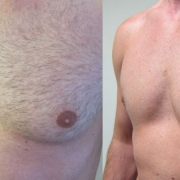
Gyno correction is a common treatment here at The STAIANO Clinic and because all of our surgeons are fully trained plastic surgeons, we have developed techniques that can produce results with minimal or no visible scarring.

Gynaecomastia is a common problem amongst young males and it can affect self-confidence and may also be uncomfortable.

If you want to be able to take your children swimming or go on a beach holiday with your friends, it can be daunting to take your top off in public when you have excess breast tissue (it goes by many names – man boobs, gynaecomastia, gyno – but it is all the same thing, excessive breast tissue in a man).

If you are considering gyno correction, the last thing you want is visible scarring on your chest that is going to make you as self-conscious as the original problem.

We take care to place our incisions in places where they will fade and blend in to your normal chest contour and so, once things have settled, it can be impossible to see the scars!

If you want to know more about gyno correction, look no further.

Download a FREE copy of our Guide with Frequently Asked Questions about Gyno Correction

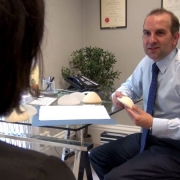
Listen to the our Director, Jonathan Staiano talk about this with some examples of our cases in the video below:

All of the surgeons at The STAIANO Clinic are fully trained plastic surgeons with a wealth of experience and expertise.  We pride ourselves in our aftercare and will do everything that we can to ensure that you get the best result possible.

You can read more about correction of gynaecomastia on our main page here and you can also read our blog post about why there is a price range for gynaecomastia correction here.

REQUEST A PRICE FOR GYNO CORRECTION

If you would like more information, please call us on 0121 454 3680 or email us.

SUBSCRIBE TO MY BLOG

Breast Uplift With Implants

Have you been looking for more information on having a breast uplift with implants?

In this video Jonathan talks about the combined procedure of having a breast uplift with implants.

Not all plastic surgeons will perform the operation of a breast uplift with implants because it is a difficult operation with a relatively high complication rate.

Here at The Staiano Clinic, we do offer breast uplift with implants as a single operation, but we discuss the potential risks as well as the benefits of performing it in a single operation.
Like many things in plastic surgery, there are no rights or wrongs and it is up to you as an individual to get as much information as you can to allow you to make a balanced decision about what is right for you.
There is no doubt that a breast uplift with implants can produce dramatic changes to the breast and in selected cases is the best way to improve the shape of the breasts.  However, you might want to consider either staging the procedure or maybe even just having a breast uplift or breast implants as you may be happy once the shape or the volume have been improved.
Listen to Jonathan discuss the benefits and risks of a breast uplift with implants with examples of his work.

If you have any questions, you can find Jonathan on Facebook Live every Tuesday at 7pm for a live Q&A, so please like our page and join in.
If you would like any further information, please visit our page at https://www.staianoplasticsurgery.co.uk/breast-lift.
You can also call us on 0121 454 3680 or email: [email protected]

Capsular Contracture After Breast Augmentation.

What Is Capsular Contracture?

Capsular contracture can happen to breast implants over time.

All implants have a capsule that forms around them.

A capsule is made up of scar tissue and it is the body’s reaction to the implant.

It is a normal reaction and it happens to all implants, no matter where they are in the body – in your hip, or your heart, in your chin or your eye.

The capsule is normal scar tissue and is nothing to worry about.

Over time the capsule (like all scar tissue) tends to contract and it is the capsular contracture that is the problem.

The problem is not with the implant, the problem is with the scar tissue that forms around the implant.

If an implant is solid like a hip implant or a chin implant, the contracture of the scar tissue does not have much of an effect on the implant.
However if the implant is soft, like a breast implant, then the contracture does have a constricting effect on the implant and this is what causes the problem.


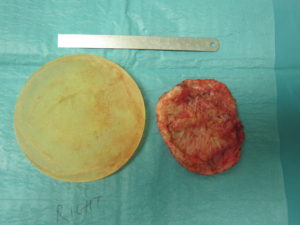
Breast implant having been removed from its surrounding capsule, seen side by side.

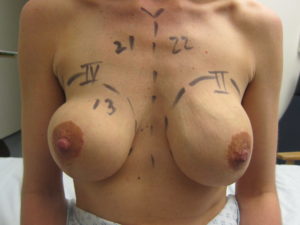
Capsular contracture is a progressive condition and over time, the implant can start to feel hard, then it can start to look ’rounded’ and then it becomes uncomfortable.
That is the natural history of capsular contracture.
Capsular contracture is graded according to the following scale (Baker classification):

  1. Grade I capsular contracture: you cannot see or feel your breast implants (i.e. everybody has at least a Grade I capsule)
  2. Grade II capsular contracture: you can feel but you cannot see your breast implants
  3. Grade III capsular contracture: you can feel and see your breast implants
  4. Grade IV capsular contracture: your breast implants feel painful

No matter what the shape or profile of your implant, when the scar tissue contracts around it, it becomes spherical, like a ball.

This can make your breast look unsightly and feel uncomfortable.

For whatever reason, capsular contracture often only happens on one side which can lead to your breasts looking asymmetrical.


Capsular contracture is a progressive condition but it is usually very slow to progress.
Capsular contracture does not need to be treated and it is your choice whether you have your implants replaced.

Prevention Of Capsular Contracture

There are a number of potential causes for capsular contracture that we work hard to avoid in order to minimise the risk of capsular contracture.

Small amounts of infection around the breast implant or a collection of blood around the implant (haematoma) can predispose to capsular contracture.

We do everything we can to minimise the risk of infection with breast implants and are very careful to control any bleeding at the time of surgery.

Fortunately the risk of infection and haematoma are very low after breast implant surgery.

Using textured rather than smooth breast implants and placing the implants under the muscle has also been shown to reduce the risk of capsular contracture, but probably the most significant thing that you can do to reduce the risk of developing capsular contracture is to use polyurethane foam coated breast implants.

These implants have not been widely adopted in the U.K. but have a been used in hundreds of thousands of women worldwide.

They are controversial and like most things, they have pros and cons and you can read my blog post about them here.

I think they are good implants and I use them a lot because I do not want my patients to have problems with capsular contracture in the future, but I discuss the risks and the benefits with everyone because ultimately it is your decision as to what type of implant that you have in your body and you need to be comfortable with the choice.

Treatment Of Capsular Contracture

The good news is that capsular contracture is not a harmful condition and it is perfectly acceptable to leave it alone.

It does tend to be a progressive condition and so will probably get worse, but progression is usually slow and it can take many years for it to develop.

The bad news is that the only effective treatment of capsular contracture is surgery.

There are no tablets or creams or any other cures that have been shown to be effective in the treatment of capsular contracture.

Surgery involves removing the capsule (capsulectomy) and replacement of the breast implants.

This surgery is more extensive than the original surgery to insert the breast implants and so it is more expensive and because it is more extensive, it is more traumatic and creates more scar tissue.

Because capsular contracture happens in the first place because of scar tissue forming around the implant, another capsular contracture happens quicker after a capsulectomy and implant replacement than it does after the initial breast implant operation.

For this reason, my advice to patients is always to wait as long as possible before undergoing a capsulectomy in order to minimise the number of operations to your breast in your lifetime.

The type of surgery that can be performed on the capsule could be:


Capsulectomy

this is removal of the capsular tissue and can be partial or complete.  This can be quite an extensive operation and there is a risk of bleeding that can form a haematoma and cause the breast to swell up. This would require another visit to the operating theatre to evacuate and wash out the haematoma.  In rare situations, the capsule and the implant need to be removed as a single unit and this is known as ‘en bloc’ capsulectomy and you can read more about it here.

Capsulotomy

this is scoring of the capsule to release it and allow it to expand if a new implant is being placed (note, if you are changing from a silicone to a polyurethane implant, then a total capsulectomy should be performed to allow virgin tissue around the polyurethane implant to grow in to it).  This is usually performed in cases where there is only a mild form of capsular contracture otherwise capsulectomy would be needed.

Capsulorrhaphy

this involves using the thick tissue of the capsule to suture together areas of the breast pocket to manipulate the shape and appearance of the breast.

This is usually required in situations where the implants are being replaced because they are not sitting well in the breast pocket.
They could be:

  • Too high
  • Too low
  • Too far out to the side
  • Too close together in the middle (synmastia)

It may also be required if the implants are being replaced for smaller implants because the breast pocket may be too big.

The other situation where capsulorrhapy is useful is where there is a poor definition of the inframammary fold.  The inframammary fold is a very important feature of the breast as any surgeon who performs breast reconstruction after mastectomy will tell you.

A very important part of breast reconstruction is to recreate the inframammary fold and these techniques used in breast reconstruction can be transferred to cosmetic breast surgery if needed.

The inframammary fold is the part of the breast where a wire of a wired bra would sit.  If you look at the shape of a breast, it is not simply a dome on the chest wall.  In the upper part, there is a smooth transition from the upper chest to the upper pole of the breast, but it is important to avoid this shape in the lower pole.

The lower part of the breast has a defined and crisp fold which gives a natural shape to the breast as it sits on the chest wall.

This is important, not only so that the wire of a wired bra sits comfortably, but also to give a normal and natural look to the breast. If there is blunting of the sharp angle at the inframammary fold, then the breast lacks aesthetic appeal.

It can be difficult to recreate the inframammary fold in situations where it is not well defined, either following breast enlargement surgery or as a result of your natural breast shape.  This can involve a combination of internal sutures and capsulorrhaphy.

Do I Need A Total Capsulectomy?

A total capsulectomy involves the removal of the entire breast capsule which is the scar tissue that surrounds your breast implant and will result in a fresh pocket for the new implant to be placed in to.

There are several factors that may influence the need for a total capsulectomy:

  1. Implant-related complications: If you are experiencing complications such as capsular contracture (excessive scar tissue formation around the implant) or breast implant-associated illness, a total capsulectomy may be recommended to address these issues.  In the rare situation of having a cancer associated with your breast implant capsule, such as BIA-ALCL, then a total capsulectomy would be required and it is this situation that an en bloc capsulectomy would be indicated.
  2. Personal preference: Some individuals may choose a total breast capsulectomy for peace of mind, even in the absence of complications. This decision may be influenced by concerns about the long-term effects of implants.
  3. Pathology findings: If there are concerns about the presence of abnormal tissue or if the surgeon suspects any pathology within the capsule, a total breast capsulectomy may be recommended. The removed capsule can be sent for pathological examination to provide further insight.

What Are The Risks Of A Total Capsulectomy?

It is worth noting that a total breast capsulectomy is a more extensive procedure compared to a partial capsulectomy.  Not only does it create more bleeding and more scarring, which could lead to another capsule forming more quickly in the future, but there are also more risks.

We always aim to leave your natural breast tissue behind and only remove the scar tissue of the capsule itself, but there will inevitably be some breast tissue removed during capsulectomy.  The more of the capsule that is removed, the more breast tissue and volume that is removed and this may make your breast smaller and reduce the amount of natural tissue covering the implant and increase the risk of being able to feel the implant or seeing the edge or rippling.

There is an added danger when performing a total capsulectomy when the implants are placed behind the muscle.  The back wall of the implant will be sitting directly on your rib cage and if your capsular contracture is stuck to your rib cage, there is a risk of making a hole in the covering of the lungs when removing the posterior capsule.  This can lead to a pneumothorax, and while it is only a very small hole that may be caused which will usually heal itself with minimal intervention, it is another thing to consider.

Do I Need A Capsulectomy If I Am Not Having Implants Replaced?

The most common problem with capsular contracture is the fact that it makes the breast feel hard.  This is because the implant is made of soft, pliable silicone gel and the scar tissue contracts around this.

If the implant is removed, then the scar tissue no longer has anything to contract against and so the breast will no longer feel hard and the capsule itself does not need to be removed if you are not replacing implants.

If you have any concerns about your capsule for instance if you are worried about breast implant illness or ALCL, then you may want to have your capsule removed at the same time as having your breast implants removed.  This could be in the form of a total capsulectomy or an en bloc capsulectomy. You can read about en bloc capsulectomy here.

Want To Know More About Capsular Contracture?

If you have any questions about capsular contracture or if you are worried about your breast implants, then you can get in touch with us here.

If you would like a free copy of our Brochure, then you can request one here.

You can also see Mr Staiano, our director, on Instagram and Facebook Live every Tuesday evening at 7pm, so you can ask questions there or post your questions to [email protected] beforehand using the hashtag #AskJJ.

B-Lite Implants – Should we be protecting our patients from them?

I was very pleased to see the arrival of B-Lite implants recently on visiting one of our plastic surgery conferences.
The concept of manufacturing an implant that is lighter than the standard silicone implant is something that I heard about some time ago.
I talk about them in one of my Facebook Live Q&A’s here:

When I discussed this amongst a panel of experts I was in a few years ago, we were uniformly agreed that it would be beneficial if there could be a lightweight implant.
My patients often comment on the weight of implants and although I am always quick to point out that they feel heavier when you hold them in your hand compared to when they are in your body (because of the moment effect, see below). Nonetheless, they do still have a weight and obviously the bigger the implant the heavier they are.

B-Lite Implants – The Moment Effect

The moment effect is something that you might have heard about from your maths lessons and it is the concept that when a weight is held further away from a pivot point it creates a greater downward force than when it is closer to the pivot point.

This is why when you hold a box out with your arms stretched it feels heavier than if you hold it close to your body and so when breast implants are held in your hand or placed in your bra they feel heavier than when they are implanted in your chest and therefore closer to your body.

There is no doubt that breast implants alleviate a huge amount of suffering and unhappiness by restoring volume and shape to the breasts.

However, it is also true that carrying excess weight in your breasts can be uncomfortable which is why breast reduction surgery has such a high patient satisfaction rate.

The B-Lite implants are now available in the UK and you might think:

Great, we no longer use standard implants anymore.

However, you will find that we are very cautious about introducing new things, particularly in medicine.

This is particularly true in the field of breast implants with the recent PIP scandal although the PIP scandal was not created because a new implant was introduced to the market.

The PIP scandal was created because of criminal activity of an implant manufacturer in France.

Nevertheless, it has tainted the whole industry and made everyone even more cautious than they already were.

I am a believer in offering my patients all the available options which is why for some time now I have offered polyurethane foam implants where many of my colleagues do not even inform patients of their existence because they do not use them.

This is how I feel about the B-Lite implants.

They are new and I tell everyone that they are new and they are also more expensive than standard implants and so they may not be for everyone.

I also have to say that in my practice I do not tend to use very large implants as most of my patients are looking for a natural result in keeping with their frame.

I do not really see patients who have problems with the weight of their implants.

Having said that I am happy to talk about them although I do not necessarily recommend them because we do not have a large experience of their use and so we do not know what the results will be like in 5 or 10 years.

On talking to some of my colleagues, I know that they do not offer or mention these implants for this very reason because they want to see the long-term results.

This is perfectly understandable.

However, it does leave me to think whether we can be too paternalistic towards our patients sometimes.

As doctors go, I see myself as being on the conservative side.

I am not one to embrace new technologies or devices as any rep who has come to see me will tell you.

I certainly do not believe in trying to look for solutions to problems that do not exist.

In my breast reconstruction practice there are always new types of mesh or glue that are being introduced and claims that they will transform the operative time or the postoperative stay.

I have never been one to adopt them and would rather see the outcome through long term patient studies.

This is why I found it odd to be at the other end of the argument with the B-Lite implants and my colleagues were saying that they prefer to wait and see long term results.

I think the difference is that there is a significant element of patient choice when it comes to implant selection which is not true in breast reconstruction.

When it comes to selection of type of suture or mesh or whether glue is used or not with a reconstruction, I do not feel that the patient will have a significant opinion on this, so I feel I can make that decision on my own without involving the patient.

There are many patients who are happy to leave it up to the surgeon as to the type of implant too, but then there are also those who get very involved with the implant selection.

This is understandable because it is something that is going to go into their body for a very long time.

I do my best to facilitate the decision and present the pros and cons of each type of implant and I certainly have my own preferred makes and manufacturers but I am not tied to any particular make and so happy to discuss and offer any of the implants available as I have used most of them.

This is how I feel about B-Lite implants and I simply inform patients that they exist and give them as much evidence as I can so they can make an informed decision as to whether it is something that might be right for them or not.

It is not like they are a prototype or unlicensed, as they have all the relevant approval to be used in the UK. They are actually made in the Polytech factory which makes the polyurethane implants that we use.

I know that patients can be swayed by what we say and there is a lot of hyperbole used in breast augmentation surgery talking about the best method for this or the most advanced technique for that, but when it comes down to it, there is often no strong scientific evidence to support one method or technique over another and it is just an opinion, not facts.

Our job as doctors is to work through the opinion and look at the facts.

I also think our job is to pass those facts on to you to help you make a balanced and informed decision.

I will continue to mention B-Lite implants to my patients and give my opinion, but I will try not to sway you one way or another.

Download our FREE Guide: BREAST IMPLANTS – YOUR QUESTIONS ANSWERED


Size Doesn’t Matter

In this video Jonathan discusses why size is not the only factor to consider when it comes to choosing breast implants.

You can find out more about how we help you to choose the right breast implant size using our Trident Approach by clicking here.

Register for my webinar where I talk about how to choose the right breast implant size and shape to give you the result you desire.

When Should You Change Breast Implants?

There is a lot of information about when to change breast implants but it is important to separate the facts from opinions.

  • Have you heard that you need to change breast implants every 10 years?
  • Do you know what to look out for if you have had your implants in for several years?
  • Do you need to change breast implants if you have a capsular contracture?
  • How can you tell if your implants have ruptured?
  • Do you need to have a check up of your implants at a certain time?
  • Are there risks if you were to change breast implants?

Jonathan is one of the UK’s leading plastic surgeons with a practice dedicated to cosmetic breast surgery. If you are worried or just curious about whether your breast implants need to be changed, watch this video to find out the answers.

If you have any questions or would like to come to the Staiano Clinic to have your breast implants checked, please get in touch and one of the team will be happy to help.

The 2nd Biggest Fear That Breast Enlargement Patients Have – Wide Cleavage

I am worried about a wide cleavage.

Probably the second biggest fear that patients having breast enlargement have is that they will be left with a wide cleavage (the first biggest fear is that they will look like Dolly Parton or Jordan).
This is not something that I see very much in my practice, but when patients search on the internet they find photographs of women with abnormally wide cleavages and they are worried that they might end up looking like this.

A wide cleavage is one of the biggest fears of breast enlargement patients.

Wonder Woman with a wide cleavage

This sort of result is an unnatural look and is usually caused by having implants placed in a submuscular plane without releasing the muscle sufficiently in the cleavage area.

Don’t worry so much about the size of the implant

I always make a point to my patients that choosing the size of the implant is an important part of the process to get the desired result. However, it is only one small part and I find that patients worry an awful lot about this and put a lot of importance on it. I see patients who have a lot of angst and sleepless nights trying to decide between two implants which may have 30cc or 50cc difference between them and so would not give dramatically different results. What is more important than the size of the implant is the shape of the implant, both in terms of its width and its projection and whether it is round or teardrop shape.

The position of the implant is crucial

The other thing that is crucially important is positioning of the implant as it does not matter what implant you choose, if it is not positioned correctly, then you will not have a good result. However, positioning the implant is entirely in the hands of your surgeon and is not something that patients tend to worry about but it is a reason to make sure that you choose you surgeon well and have confidence in his or her abilities. A widely spaced cleavage is an example of an implant that has not been positioned well.

What causes a widely spaced cleavage?

When making a space underneath the muscle there are quite large blood vessels supplying the muscle in the cleavage area. Surgeons like myself, who have experience of microsurgical breast reconstruction are very familiar with these blood vessels as we actually dissect them out and connect them to blood vessels from pieces of tissues transferred from the tummy in order to reconstruct the breast after mastectomy. It is very important to be aware of the presence of these blood vessels because this area needs to be adequately released in order to place the implant in the right position to enhance the cleavage. If the muscle is not adequately released, it can pull the implant sideways creating this very wide appearance which looks unsightly and unnatural.
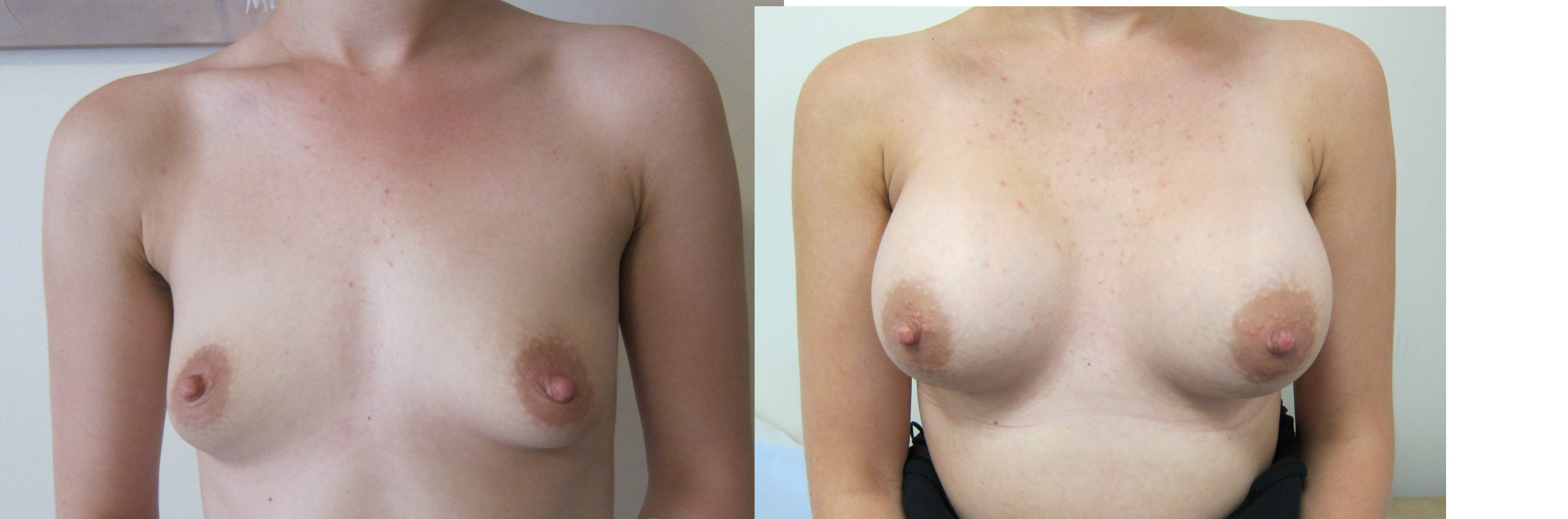
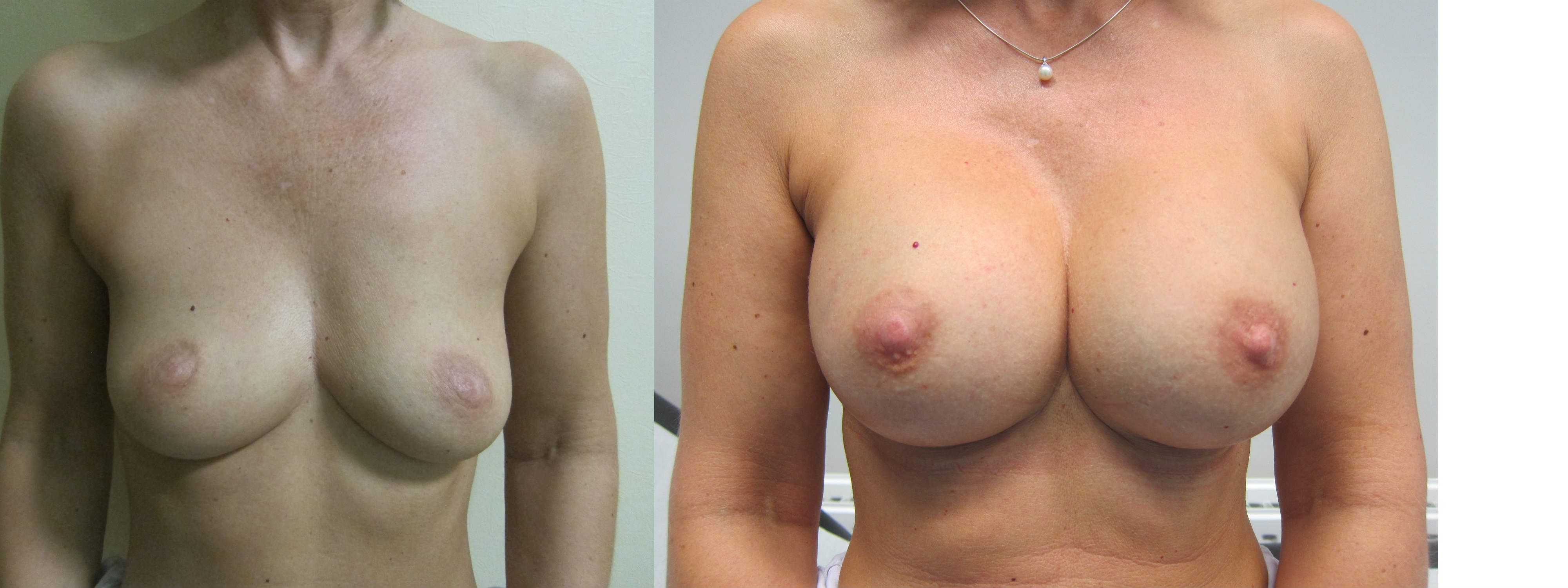
Having said this, I always stress to my patients that the appearance of the cleavage area does differ between individuals. Some individuals have breasts that sit quite close together whilst others are slightly more widely spaced. The aim of breast augmentation surgery is to enhance the natural breast that you have. The examples below show good results with a pleasing enhancement of the cleavage area but you will note that the patient on the top has a slightly wider cleavage naturally than the patient on the bottom.

natural wide cleavage

naturally wide cleavage

naturally narrow cleavage

naturally narrow cleavage

Push up bras

The other important thing to note is that these photographs are taken with no clothes on and it is possible to manipulate the position of the breasts with clothing.  There are bras which can push the breasts together to enhance the cleavage or push the breasts up to make the upper part of the breast look fuller.

Natural Result

Surgery is all about enhancing the natural breast. There are some circumstances where the position of the breast may need to be manipulated or changed such as in cases of breast asymmetry or differences in the inframammary fold height or in tuberous breast deformity and so different skills may need to be utilised here. However, for many patients the breasts are in a natural position and breast implants can achieve an enhancement of this and an improvement in the size and shape of the breasts.

Choice of surgeon is more important than choice of implant

I hope this blog post has been useful. At the Staiano Clinic we try and empower patients and give the information that you need to make an informed decision. We do not wish to over complicate things or for you to get bogged down with small details, but it is important for you to know that the training and experience of your surgeon is critical because there is a lot more to getting a good result with breast implants than simply choosing the right size of implant.

For more details about breast implants – download our FREE guide with FAQs


Keep in touch

If you would like any further information please feel free to contact us though our website, Facebook or Twitter. If you would like to subscribe to our quarterly newsletter, please click here.
TwitterPinterestFacebookLinkedInRSS


Cosmetic surgery can be truly life-changing

We need more positive news stories.

You may have seen our patient featured in The Mirror and The Mail.
She lost a significant amount of weight (8 stone) and had lost shape and volume in her breasts.  It is a great story as she is due to be married and has worked so hard to regain her body shape.  It is heartening to see stories like this in the media, as in this day and age, plastic surgery will often get negative press.  I specialise in breast and body contouring and the vast majority of patients that I see want a natural result that is in proportion with their frame.

Cosmetic surgery is about making people look and feel better

Plastic surgery is about restoring form and function and cosmetic surgery is about enhancing and improving on this.  It is not about overdoing it, whether it be breast implants or lip fillers.  The media is full of stories of strange looking people who have overdone plastic surgery, but this is a very small minority and something that I hardly ever see.

My waiting room is full of normal people like you

The waiting room in my clinic in Edgbaston is full of mums who have lost volume in their breasts following breast feeding or have redundant skin on their tummy which will not tighten, no matter how much exercise they do.  Or people like Chantelle, who have lost weight and they feel deflated and want their shape restored.

Thank you Chantelle, we need more positive role models

Cosmetic surgery can be truly life-changing, yet so many people carry guilt and feel that they are putting themselves through unnecessary surgery.  We need more positive role models like Chantelle to show the world that plastic surgery is for normal people who want to restore their self-esteem and their confidence and that there is absolutely nothing wrong with that!

Thank you, Chantelle, for sharing your story and good luck with the wedding!  I look forward to seeing you for your follow up appointment.

Jonathan
TwitterPinterestFacebookLinkedInRSS